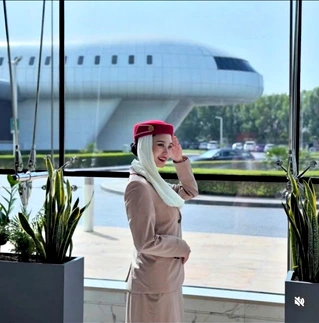
When Yuna arrived in Malaysia from Japan to train as cabin crew at Crew Lounge, her English was a smile and two words.
“When I came to Malaysia, I couldn’t speak English at all. At the beginning, I just smiled and said Good morning to everyone.” – Yuna, Crew Lounge Graduate/Emirates cabin crew
Today she is an Emirates cabin crew. Between those two points she learned the English at Crew Lounge that international airlines actually work in: not textbook grammar, but the language of the cabin, from airport codes and meal codes to the phrases you say to passengers many times on every flight.
This article walks through that language, section by section, and explains why it is far easier to learn in an environment where English is not just a school subject. If you are a Japanese student wondering whether your English is “good enough” to even start, Yuna’s story is the best place to begin.
Why aviation English comes first
Once you receive an offer from an international airline, your training takes place entirely in English. Safety procedures, in-flight service, announcements and the specialist vocabulary around them are all taught in English, and even native speakers find the volume of new terminology demanding.
The selection process happens in English too. Yuna’s Emirates assessment moved through four stages and finished with a one-to-one interview, in a room of international candidates. Composure and clear communication in an unfamiliar setting are exactly what that kind of assessment looks for, and vocabulary that already feels familiar helps you stay calm when the language gets technical. All these were taught by Crew Lounge.
Her English did not improve in a straight line
The honest version of Yuna’s story includes a low point. Early on, when her English did not seem to be improving, she wanted to go home.
“When I felt my English wasn’t improving, I really wanted to go home. I even called my family and cried on the phone.” – Yuna
She stayed. What changed things was not one big breakthrough but daily use: English classes, and time with local friends.
“Through English classes and spending time with local friends, my English improved. I used to make English sentences in my head, but one day I became able to imagine and speak it.” – Yuna
That shift, from translating in your head to simply speaking, is what every language learner is working toward. Aviation English is the same journey with a specialist vocabulary on top. The good news is that the vocabulary is learnable, and it is learnable in small pieces.
The language of the cabin: six things to learn first
Here is a small selection of the aviation English that international cabin crew use every day. It is a head start, not a complete list.
1. Airport codes
Every airport in the world has a three-letter IATA code. Cabin crew see them on every roster, boarding pass and flight plan.
- KUL – Kuala Lumpur
- DXB – Dubai
- DOH – Doha
- HND – Tokyo Haneda
- LHR – London Heathrow
- JFK – New York
A simple habit: when you see a route like KUL–DXB, say it out loud as “Kuala Lumpur to Dubai”. After a few weeks the codes become as natural as station names.
2. Cabin class abbreviations
- FC – First Class
- JC – Business Class
- YC – Economy Class
You will hear these in every pre-flight briefing, for example: “We have 30 passengers in JC today.” Abbreviations can differ slightly between airlines.
3. Special meal codes
Passengers can request special meals for dietary, religious or health reasons. Each meal has a four-letter code, and crew are responsible for serving the right meal to the right passenger.
- VGML – Vegan meal
- BBML – Baby meal
- CHML – Child meal
- MOML – Muslim meal
Getting a code wrong means a passenger with a real requirement receives the wrong meal, which is why crew drill these until they are automatic.
4. The phonetic alphabet
To avoid mistakes over the radio or the cabin interphone, aviation uses a standard spelling alphabet: A is Alpha, B is Bravo, C is Charlie, D is Delta. Seat 23C becomes “two-three Charlie”. Try spelling your own name with it, then your home address.
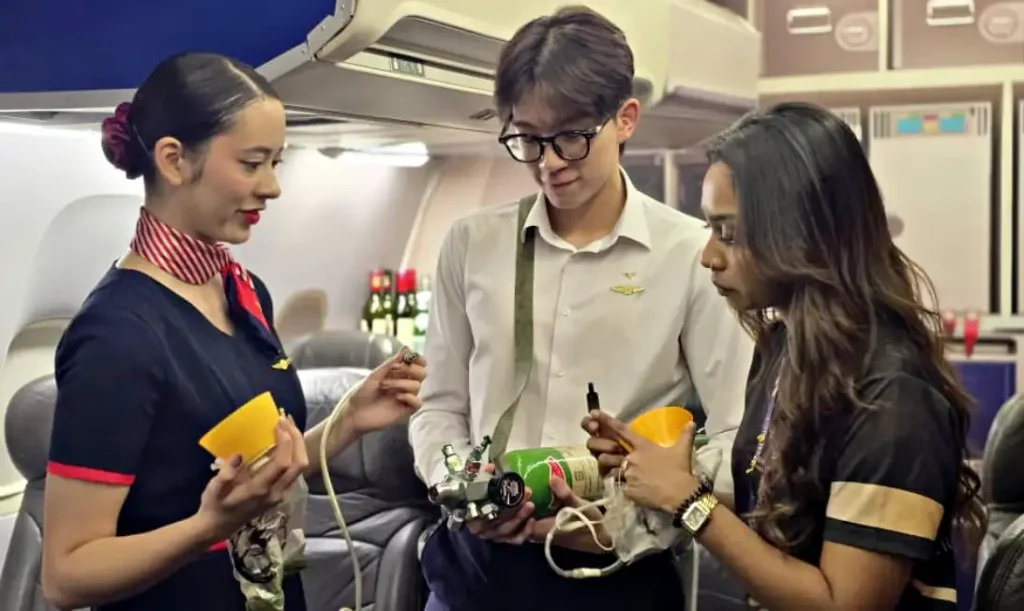
5. Onboard safety equipment
- Fire extinguisher
- Oxygen bottle
- Safety demonstration kit
At Crew Lounge, students learn with real cabin equipment, not just pictures in a textbook. Saying the name while holding the item is the fastest way to remember both.
6. Service phrases you will use on every flight
- “May I see your boarding pass, please?”
- “Would you like something to drink?”
- “Could you please fasten your seatbelt?”
- “Is there anything else I can get for you?”
The phrases are simple. What airlines notice is how you say them: warm, clear and unhurried. Crew Lounge teaches you this.
Why an English-speaking environment makes it stick
Memorising a list gets you part of the way. Using it every day gets you the rest.
Yuna’s classes at Crew Lounge ran from 10 in the morning to 4 in the afternoon and included English for aviation alongside safety and emergency procedures, service training and grooming. After class came sport, friends and ordinary daily life, all in English. She also found that her classmates changed how she thought, not only how she spoke.
“Studying with students from different backgrounds helped me learn not only English, but also different ways of thinking.” – Yuna
That is the difference between learning aviation English and living it. Read more: why studying in Malaysia builds real English
FAQ – Frequently asked questions
No. Yuna started with “Good morning”. The programme includes English for aviation and professional communication, and the lists above are a head start, not an entry requirement.
In class, with real cabin equipment, and through daily life with classmates from many countries.
This article covers a small selection. The full list, useful Malaysian English phrases and graduate interviews are in our CA Study Abroad START BOOK, free for friends of our official LINE account.
Yes. We have Japanese-speaking staff and can support you in Japanese from your first enquiry to post-training recruitment.
Start here
“Everything starts with the first step. First believe in yourself and keep moving forward. Nothing will happen unless you take action, so just start.” – Yuna
You do not need to be fluent on day one. You need to start. Add us on LINE and get the START BOOK We also hold free online consultations every week.
Want the full picture first? Read Yuna’s full story or see our IATA cabin crew training course
Crew Lounge is an IATA Premier-accredited cabin crew training academy based in Petaling Jaya, Malaysia.