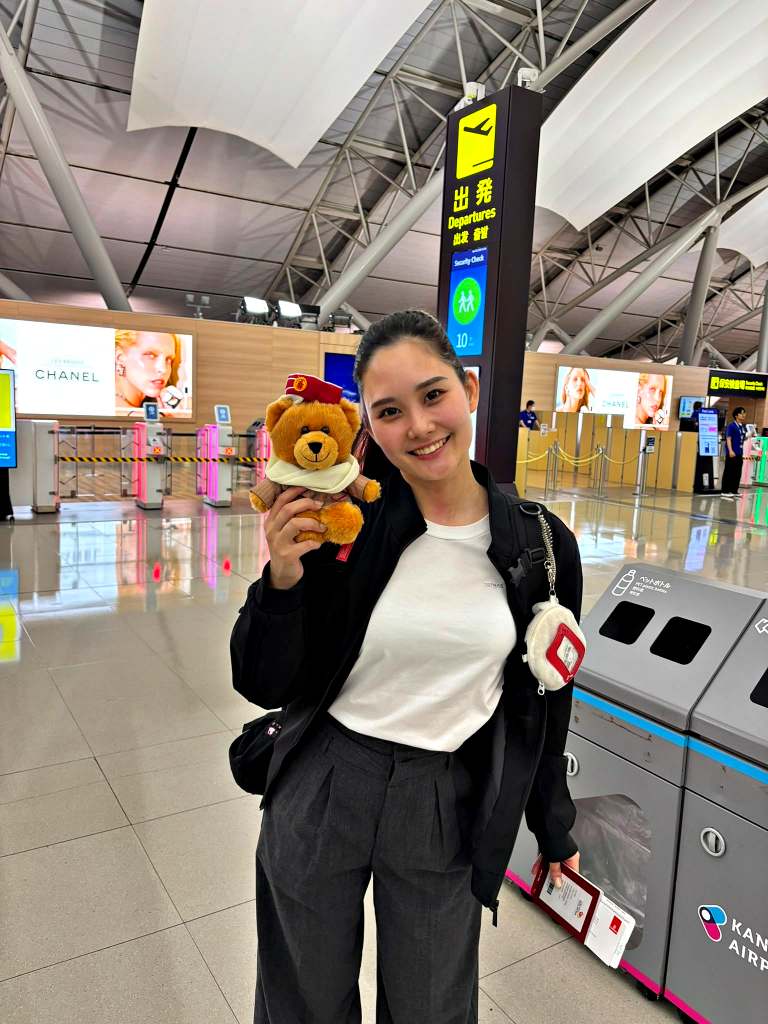
Yuna was a university student in Kyoto when she decided to stop waiting.
She had known what she wanted since she was a child. Growing up in Osaka, she visited airports often — the way some families visit parks. On one of those visits, she met an Emirates cabin crew. She spoke with them. Something settled in her mind that day and never moved.
Years later, with a degree underway and a part-time job as a sales associate and waitress, she made the decision. Not to apply to a Japanese airline. Not to take the familiar path. She chose Crew Lounge Malaysia, packed up, left Kyoto, and started again.
In June 2026, she flies to Dubai to begin her Emirates career.
This is how that happened.
Why Not Japan
Most Japanese students who want to become cabin crew (CA) start where the system points them, domestic airline preparation schools. エアラインスクール built for JAL, ANA, Japanese regional carriers. The curriculum, the interview training, the grooming standards, all of it designed for Japanese recruitment processes.
That preparation has one significant gap: it does not prepare you for Emirates.
The Emirates assessment is conducted in English. The group discussion, the individual interview, the self-introduction, all of it in a room full of international candidates, assessed by international recruiters who are looking for something specific. Composure in an unfamiliar setting. Communication that crosses cultures. A service instinct that goes beyond Japanese domestic standards, which is saying something, because those standards are exceptionally high.
Yuna understood this before she applied. She did not look at schools in Japan. She looked at what would actually get her the job.
Why Malaysia. Why Crew Lounge.
Yuna was direct about her decision.
“I thought Crew Lounge was the best place to become cabin crew. There were many experienced trainers and I could learn everything about aviation.”
Malaysia itself was also a deliberate choice, not a compromise.
“Because of the cost and environment. Malaysia is a multicultural country, Malay, Chinese, Indian and that environment was important to me.”
That environment matters more than it might appear on paper. Cabin crew work is not conducted in a single culture. It is conducted across hundreds of them, at altitude, under pressure, with passengers who need help in languages and contexts you cannot always predict. Training in a genuinely multilingual, multiracial environment is not a nice-to-have. For someone heading to Emirates — an airline that carries passengers from over 150 countries, it is the point.
On cost: cabin crew study abroad in Australia or Canada can run two to three times the price of equivalent training in Malaysia. For Japanese students weighing their options, that difference is real. Malaysia is not the cheaper option because it is lesser. It is the more rational option because the outcome is the same and in Yuna’s case, better. It’s also worth knowing what Emirates itself pays once you’re hired, tax-free income and free accommodation change the entire cost equation.
The Part Nobody Tells You About
Yuna arrived in Malaysia with basic English. Her own description of where she started is the most honest thing in this post.
“When I came to Malaysia, I couldn’t speak English at all. At the beginning, I just smiled and said Good morning to everyone.”
That is it. That was her English on arrival. A smile. Good morning.
The lowest point came early.
“When I felt my English wasn’t improving, I really wanted to go home. I even called my family and cried on the phone.”
This is the part that does not appear in the glossy version of the study abroad story. The part where you are sitting in a class you can partially follow, in a country where you know almost no one, wondering if you have made a serious mistake. Yuna was there. She called home and cried.
She did not go home. It’s the same reason immersion works when a classroom alone doesn’t.
Classes ran from 10 in the morning to 4 in the afternoon. Inside those hours, safety and emergency procedures, first class and business class service training, English for aviation, grooming and professional presentation, and the kind of communication and teamwork coaching that international airlines actually assess candidates on. Not theory sitting in a textbook. Practical, applied, repeated until it becomes instinct.
“I knew what we were going to learn before joining, but it was more practical than I expected.”
After class, sport, friends, the kind of ordinary daily life that turns classroom English into real English without you noticing it happening. That was where the language shifted for Yuna.
“Through English classes and spending time with local friends, my English improved.”
“I used to make English sentences in my head, but one day I became able to imagine and speak it.”
That shift, from translating in your head to thinking in the language, is the moment every language learner is working toward. For Yuna it came in Malaysia, living it every day, not just studying it.
“Studying with students from different backgrounds helped me learn not only English, but also different ways of thinking.”
That last part is not incidental. Emirates does not hire people who can only operate in one cultural register. The multicultural training environment at Crew Lounge is not separate from the Emirates preparation. It is part of it.
The Turning Point
There was a moment in training when it clicked.
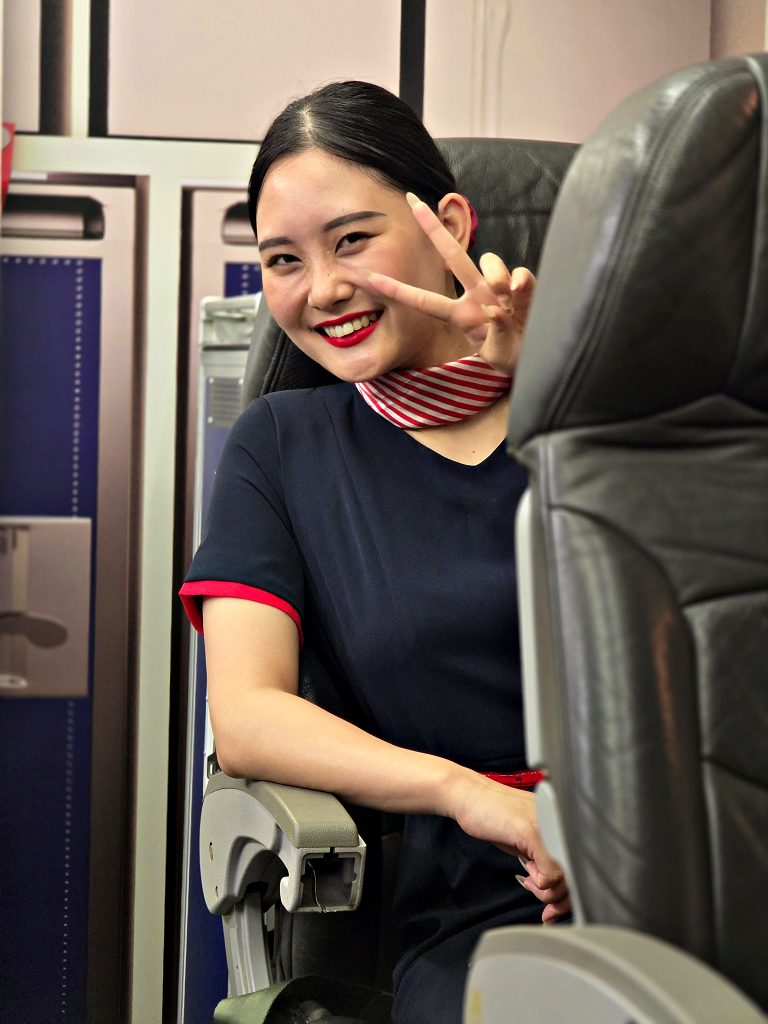
“Definitely the training class. Through this class I was able to imagine myself working as cabin crew.”
Before that class, the goal was abstract, something she was working toward. After it, she could see herself in the role. That shift in how she pictured herself is not a small thing. It shows in an assessment room.
Yuna — Emirates Cabin Crew (joining June 2025)
“Everything starts with the first step. First believe in yourself and keep moving forward. Nothing will happen unless you take action, so just start.”
What the Emirates Open Day Actually Involves
Yuna’s Emirates assessment was her first international airline application. She had applied to two Japanese airlines previously, but Emirates was different, a different process, a different scale, a different standard of preparation required.
That standard of preparation is exactly what Crew Lounge is built around. Before Yuna even received her Emirates open day invitation, Karim and Mimi the founders of Crew Lounge, and the people with the deepest knowledge of what international airline recruiters are actually looking for sat down with her and went through her CV together. Every detail that Emirates expects to see, prepared to the standard that gets candidates noticed. That process is not left to chance or guesswork, it is guided by people who understand the Emirates recruitment standard from the inside out. That work is what got her in the room.
Once the invitation came, the preparation shifted into a different gear entirely. Karim worked with Yuna directly, going through exactly how to answer the questions she would face, running interview practice sessions, and putting her through bootcamp preparation that covers not just how to perform in the room but how the entire recruitment process works from the inside. In the week leading up to the open day, that preparation intensified. The trainers who had been with her throughout the programme were part of that support. By the time Yuna arrived at the open day, she had been through it before.
The assessment moved through four stages. She was nervous at the first, she did not yet know what the recruiters were really looking for. The second brought its own uncertainty. By the third stage her hands were shaking.
“I was most anxious and worried. My hands were shaking the whole time.”
And then the fourth.
“I finally made it here. I was smiling and enjoying every moment.”
That shift, from shaking hands to smiling in the room, is not luck. It is what happens when the preparation has done its job.
What Crew Lounge changed about how she approached it:
“Before joining Crew Lounge, I thought being cabin crew was mainly about service. But I learned that safety, communication, and teamwork are the core of the role.”
That reframe matters in an assessment room. Candidates who walk in thinking cabin crew is a service job perform differently to candidates who understand it is a safety-critical, team-based, communication-intensive profession that also delivers world-class service. Emirates knows the difference. Recruiters spend all day in that room. They can tell.
The Offer
Nine days after the open day, her phone rang.
“I couldn’t believe it, and I was shaking.”
“After the phone call, I hugged my friends and trainers. The first people I told were my family because they always supported me.”
The family who talked her through the crying phone calls from Malaysia. The trainers who prepared her every day in class. Karim and Mimi, who sat with her, worked through her CV line by line, and pushed her in practice until the real thing felt familiar. The friends she made in a country she arrived in knowing almost no one.
That is what the offer moment looked like.
The Crew Lounge Programme
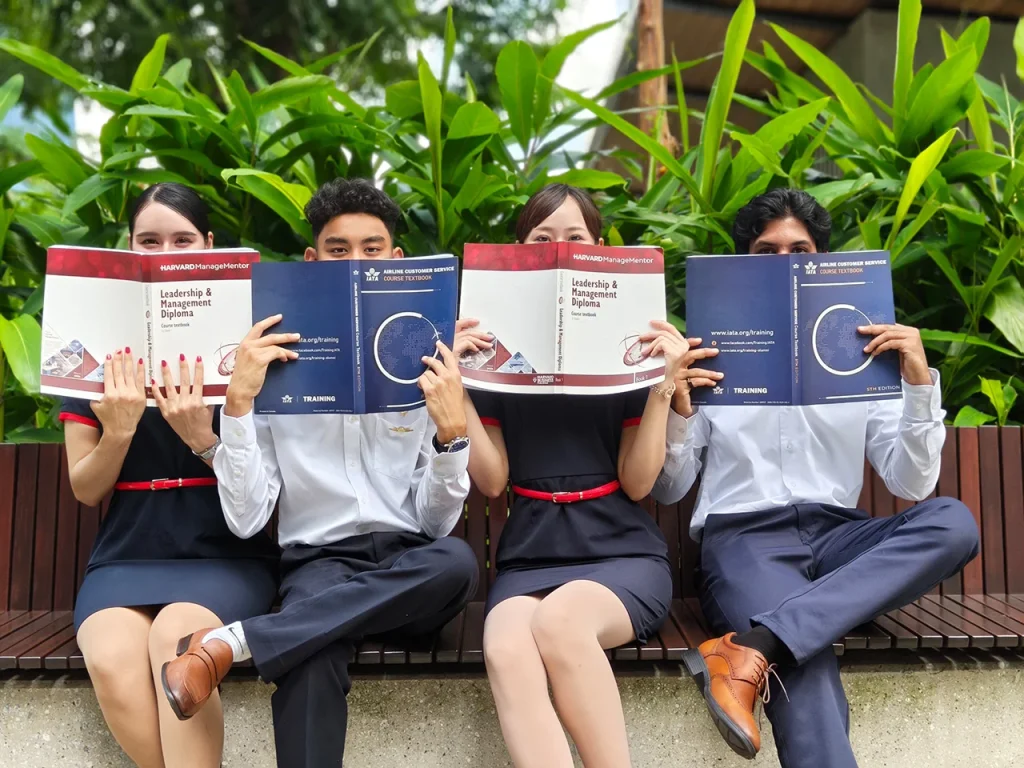
Crew Lounge offers two IATA-certified programmes:
- 1-Year Diploma in Leadership and Management – the full international qualification, covering safety, service, leadership, and management across the aviation industry
- 6-Month Customer Service Programme – focused on service excellence and international airline recruitment preparation.
Both programmes include:
- Safety and emergency procedures to ICAO international standards
- First class and business class in-flight service training
- English for aviation and professional communication
- Airline assessment preparation — group exercises, individual interviews, walk and turn
- Grooming and professional presentation coaching
- Personal CV and interview preparation with Crew Lounge founders Karim and Mimi for every student who secures an airline interview
- Access to Emirates and other airline open day events through Crew Lounge’s recruitment network
Yuna completed her programme, attended the Emirates open day with our support, and received her offer. That is the process. It is repeatable. It’s the same process that placed graduate Kirari, and graduates Mana and Rino at Qatar Airways.
FAQ (Frequently Asked Questions)
Yuna arrived with basic English. She left with an Emirates offer. The programme builds your English to the standard required for international airline assessments through class, through daily life, and through training alongside students from different countries. What matters most on day one is the decision to improve, not the level you start at.
Yes. We have Japanese-speaking staff and can support you through everything from your first enquiry to post-training recruitment in Japanese. You can also speak directly with Japanese alumni, including graduates now flying with Emirates, Qatar Airways, Singapore Airlines, and Etihad.
Emirates holds recruitment open days in Kuala Lumpur regularly, and periodically across Asia. Being based in Malaysia during your training puts you close to these events. Crew Lounge tracks open days, shares information with students, and prepares them specifically for each stage of the Emirates process.
Full fees are covered in your free consultation. Training in Malaysia is substantially more affordable than equivalent IATA-certified programmes in Japan, Australia, or Canada.
Many of our graduates received their offer after more than one attempt. Crew Lounge continues to support students through multiple recruitment rounds, one rejection is not the end. It is preparation for the next opportunity.
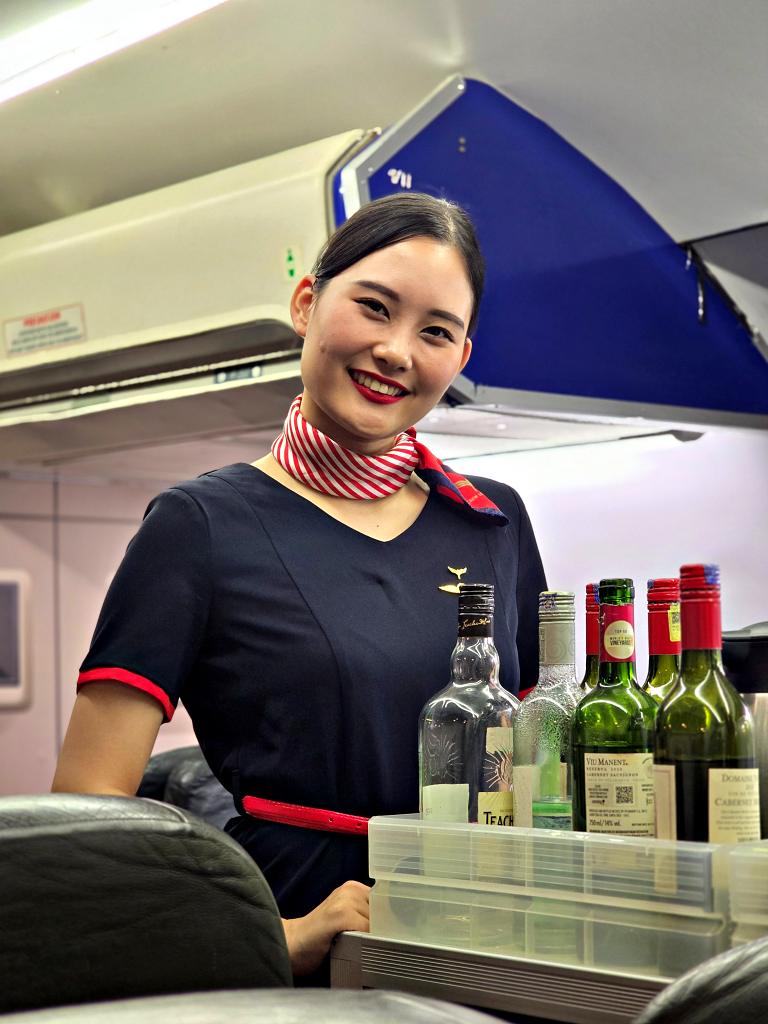
Two Weeks
Yuna is nervous. She said so directly, worried about the training ahead, about moving to Dubai, about everything that comes after the offer.
She is also the most excited she has been in her life.
“My dream is about to come true.”
She was asked what she would say to a Japanese student sitting where she was a year ago, unsure if this was actually possible for them.
“Everything starts with the first step. First believe in yourself and keep moving forward. Nothing will happen unless you take action, so just start.”
She learned that in Malaysia. She is taking it to Dubai.
Start Here
Yuna is not a rare exception. She is the result of a training programme built specifically to get Japanese students into international airlines and a recruitment process that works.
Cabin crew (CA) study abroad in Malaysia is the most direct, most affordable, and most proven route for Japanese students pursuing a career at Emirates or other world-class airlines.
If that is the path you want, the next step is a free consultation with Crew Lounge in English or Japanese.
Book Your Free Consultation → Prefer to message first? Find us on LINE.
Crew Lounge is an IATA Premier-accredited cabin crew training academy based in Petaling Jaya, Malaysia. Our graduates are currently flying with Emirates, Qatar Airways, Singapore Airlines, Etihad Airways, Cathay Pacific, Malaysia Airlines and more.