Missed the Graduate Intake? How Career Changers Become International CA合格
“I missed my chance to become cabin crew as a new graduate.” “I’ve been working for a few years, but I still can’t let go of the dream.”
If either sentence sounds like you, the door is not closed. International airlines recruit very differently from Japanese airlines, and many of the things that worry career changers most turn out to be more manageable than they look. This article covers five of them: how international recruitment works, the requirements to check, why your work experience counts, how to build your English, and when to leave your job.

1. International airlines do not recruit like Japanese airlines
Japanese airlines are known for a once-a-year graduate intake. Many international airlines work differently. They recruit throughout the year through open days and assessment days, and what they assess is what you show on the day: your English, your service mindset and how you present yourself, not the year you graduated.
Open days follow a format. Yuna’s Emirates assessment, for example, moved through four stages and ended with a one-to-one interview. Knowing the format in advance, and practising for it, is a big part of preparation. How does international cabin crew pay compare with Japanese airlines?
2. Check each airline’s requirements first
Requirements differ from airline to airline, and they change. As of our latest check in September 2026:
- Emirates: minimum age 21, minimum height 160cm, arm reach 212cm, and Grade 12 education.
- Qatar Airways: arm reach 212cm and 10 years of education. No TOEIC score or IATA certificate is required.
- Etihad: age 21, height 163cm, Grade 12, no arm reach listed. This differs from Emirates, so don’t group the two.
- Singapore Airlines: age 18, 158cm women / 165cm men. Education depends on the base.
- AirAsia: age 18, 157cm women / 170cm men, arm reach 210cm.
- Malaysia Airlines: age 18 to 35, 157cm women / 165cm men, diploma required, work visa needed.
- Cathay Pacific: age 18, reach 208cm, high school diploma, plus one extra Asian language for Hong Kong roles.
- Vietnam Airlines: age 18 to 30 for women and 18 to 32 for men, with height ranges and 212cm reach.
- Crew Lounge entry requirement: 157cm for women, 165cm for men. (Shorter candidates may still apply for ground roles.)
3. Your work experience is a strength
Looking after customers, working as part of a team, staying calm when things go wrong: these are exactly the qualities airlines look for, and a few years of working life gives you real examples of each.
In an interview, a specific story from your job is more convincing than a general statement about being a team player. Start collecting those stories now: a difficult customer you handled, a deadline the team met together, a time you stayed calm under pressure.
4. English is the biggest hurdle, and it can be built
Interviews and training are all in English, and this is what most career changers worry about. English grows with the right environment.
Yuna was a university student rather than a career changer, but her starting point is the one many career changers fear. She arrived in Malaysia barely able to speak English.
“When I came to Malaysia, I couldn’t speak English at all. At the beginning, I just smiled and said Good morning to everyone.” – Yuna, Crew Lounge graduate now Emirates cabin crew
She also wanted to go home when progress felt slow. She stayed, and through classes and daily life with local friends her English improved until she received an offer from Emirates. Read Yuna’s story
5. Plan when to leave your job
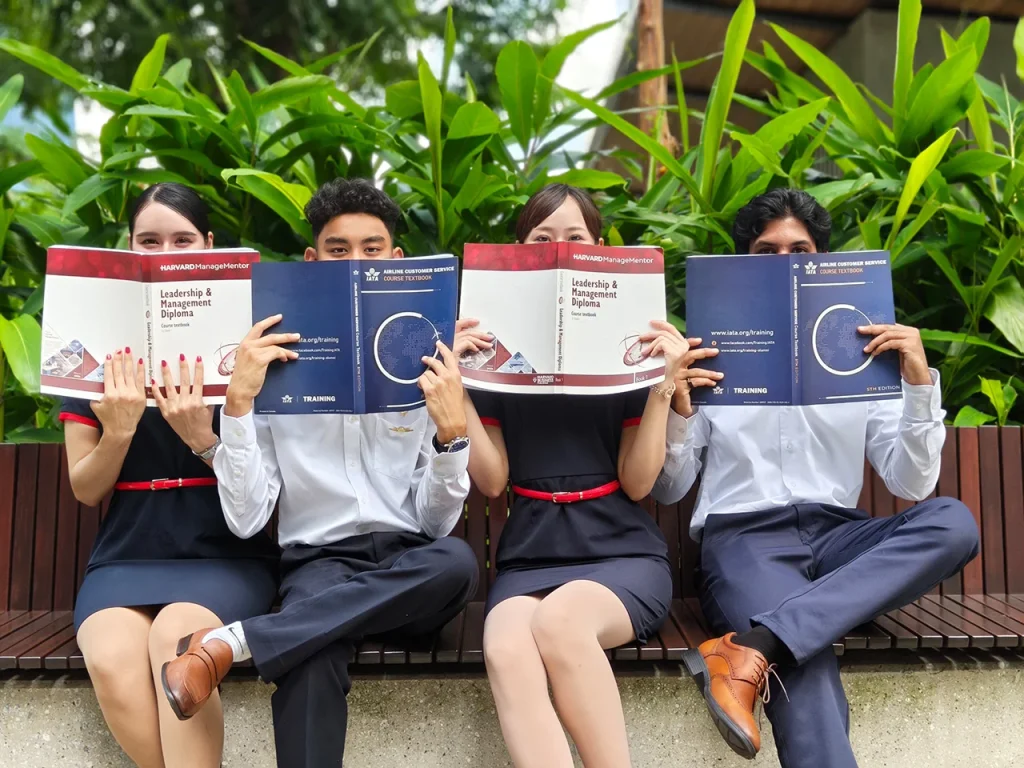
Some people start preparing while they are still working. Others take the step to study full-time. Crew Lounge offers two IATA-certified programmes, a 1-Year Diploma in Leadership and Management and a 6-Month Customer Service Programme, so you can choose what fits your situation.
Students also receive personal CV preparation and interview bootcamp with Crew Lounge founders Karim and Mimi when they secure an airline interview. Many of our graduates received their offer after more than one attempt, and we support students through multiple rounds. About our IATA cabin crew training course.
The key is to make a plan and start, rather than wait for the “perfect” moment.
From someone who made the change
Utano worked as a hotel receptionist in Tokyo for three years before she joined Crew Lounge. Here, in her own words, is why she changed direction, what worried her, and what she would say to anyone still hesitating.
Why she decided to aim for cabin crew:
“After the COVID-19 pandemic, I had more opportunities to assist guests from overseas. This made me realize that I wanted to use English more in my work, work with people from different countries, and have a career that would allow me to work overseas.”
Her biggest worry was English, even though she had studied abroad at university:
“My biggest concern was my English. I had studied abroad when I was a university student, so I could communicate in English at a daily conversational level. However, I had never worked overseas or had an interview in English, so I was worried about whether my English was good enough to actually work abroad and whether I could handle an interview in English.” – Utano
What changed that:
“I was attracted to the fact that I could learn about cabin crew training in English before actually joining an airline. I also liked the fact that Crew Lounge is in Malaysia, where I could communicate with people from different backgrounds and get used to hearing a variety of English accents.”
“With the interview practice and support from Karim and Mimi, I gradually became more confident. I was able to challenge myself to attend interviews with international airlines, something I could not try when I was still in Japan.”
And her hotel years turned out to count in the interview room:
“In fact, in many of the airline interviews I have attended, I have been asked a lot of questions about my previous hotel experience, so my work experience has been very helpful throughout the interview process.” – Utano
Her message to anyone hesitating:
“If you don’t take action, you cannot get any closer to your dream. The earlier you take that first step, the more opportunities you have to learn from your experiences, even if things don’t go as planned.”
“And your previous work experience is not a detour. It can actually become one of your biggest strengths.” – Utano
FAQ – Frequently asked questions
Many international airlines recruit through open days and assessment days throughout the year rather than a once-a-year graduate intake. What matters on the day is your English, your service mindset and how you present yourself.
Not necessarily. Some people prepare while working, and others study full-time. Crew Lounge’s 6-month and 1-year courses give you a choice.
Not according to our latest check, but always confirm on the airline’s official site. Studying with us gives you the IATA-certified training and the English practice that assessments depend on.
Yes. We have Japanese-speaking staff and can support you in Japanese from your first enquiry to post-training recruitment.
Not sure where to start?
You do not have to work it out alone. Talk to us free on LINE or join one of our free weekly online consultations. We will help you check the requirements and plan your timing.
Crew Lounge is an IATA Premier-accredited cabin crew training academy based in Petaling Jaya, Malaysia.